Inside CrowdStrike’s Science-Backed Approach to Building Expert SOC Agents
Security teams are at a critical inflection point. AI-enabled adversaries now operate at machine speed, automating phases of the kill chain and scaling attacks faster than human-only workflows can respond. Yet most SOCs still depend on manual triage and investigation processes that cannot keep pace.
This has fueled an explosion of SOC agents across the cybersecurity landscape. The appeal is obvious: Triage and investigation are among the most intuitive and consequential tasks for AI to transform because the first decisions in the lifetime of a detection can shape the entire trajectory of the response. Just as in medicine, inaccurate triage can lead to misallocated resources, delayed intervention, or signals going unnoticed during critical response windows.
With so many SOC agents entering the market, organizations are struggling to determine which agents have the proven accuracy to meet the demands of today’s high‑stakes SOC environment.
This blog breaks down why only a science-backed approach to agent training, testing, and refinement can deliver agents worthy of operating in the SOC — and how this principled methodology underpins CrowdStrike® Charlotte AI™ Detection Triage and Response agents.
Should All SOC Agents Be Trusted?
For most, the answer is no. Many “agents” are little more than simple automated workflows that call off-the-shelf large language models (LLMs) — systems that mimic expertise rather than embody it. They may look impressive in demos, but without expert grounding, scientific benchmarking, or rigorous feedback loops, their accuracy collapses under real-world conditions. They’re inconsistent, unpredictable, and risky.
Security teams don’t need agents that sound confident. They need agents that meet the bar required for an agentic SOC: Agents trained on real analyst judgment and capable of analyst-grade decision-making, not just surface-level pattern recognition. They need agents that are transparently tested, measured, continuously refined, and governed by strict guardrails for safe, consistent orchestration.
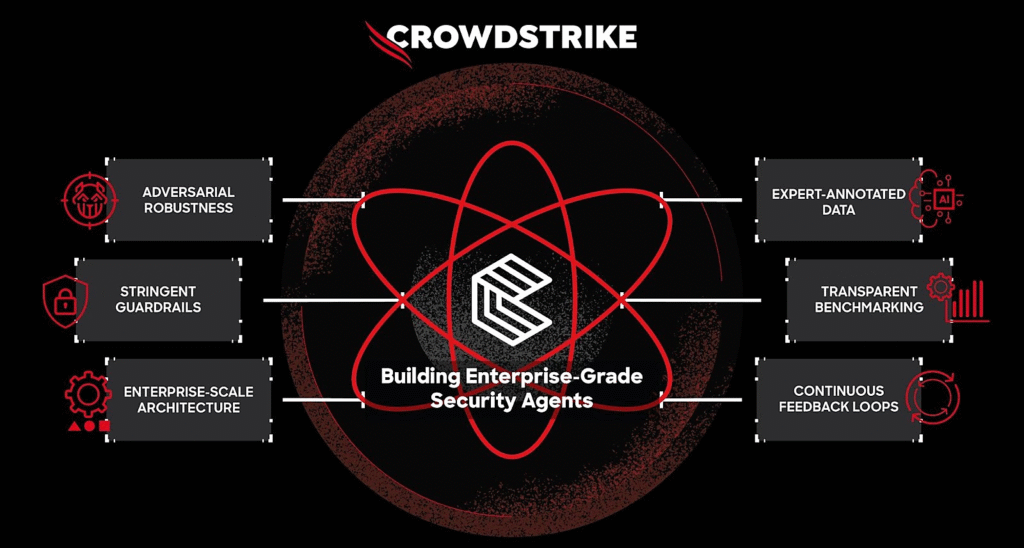
The Six Pillars of Building Mission-Ready Agents
To make an agent worthy of operating in the SOC, six criteria must be met: training on expert-annotated data, measurable and transparent benchmarking, continuous monitoring and feedback loops, a purpose-built architecture for enterprise scale, stringent guardrails, and adversarial robustness.